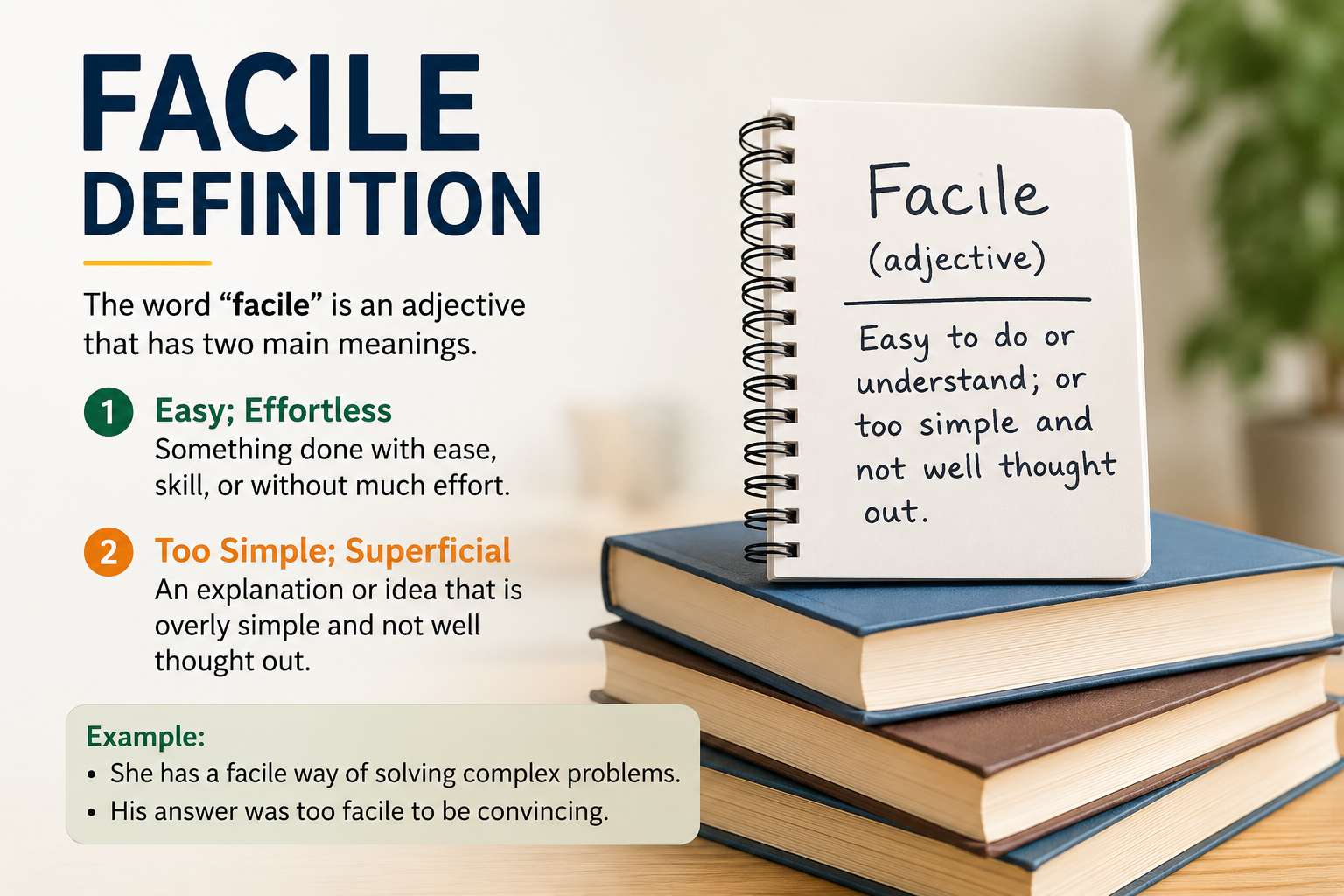
Facile Definition, If you have come across the word “facile” and wondered what it means, you are not alone. It is a useful English adjective, but its meaning can change slightly depending on the context. The word is commonly associated with something that is easy, effortless, or achieved with little difficulty. However, when it describes an explanation, argument, answer, or judgment, facile can suggest that something is too simple and has not received enough careful thought. Cambridge Dictionary gives both senses, while Oxford also identifies a negative sense connected with ideas or statements produced without sufficient effort or careful consideration.
What Does Facile Mean?
The simplest facile definition is “easy” or “effortless,” but that explanation does not cover every situation. In modern English, facile is often used when something appears easy because it has been handled quickly or without much difficulty. For example, someone might describe a skilled writer as having a facile style because the person can write smoothly and naturally. Cambridge also lists meanings connected with being skillful, fluent, or effortless in certain contexts.
At the same time, facile can have a negative meaning. If someone gives a facile answer to a difficult question, the problem is not necessarily that the answer is completely wrong. Instead, the criticism is that the answer is overly simple and does not seriously consider the complexity of the issue. This distinction is important because it helps you understand why “facile” can sound positive in one sentence and negative in another.
Facile Definition in English
In everyday English, facile is generally used as an adjective. One meaning describes something that is done easily or with apparent skill. Another meaning, which is particularly common in formal writing, describes an idea or statement that is too simplistic or insufficiently considered. Cambridge defines a facile remark or theory as one that is too simple and has not been thought about enough.
For example, consider the sentence: “She provided a facile explanation of the problem.” This usually means the explanation was too simple for the situation. On the other hand, “The musician gave a facile performance” can suggest that the performance was smooth and skillful. The surrounding words and subject therefore determine whether facile carries a positive, neutral, or negative sense.
Facile as “Easy”
One important meaning of Facile Definition is something that requires little effort. In this sense, it is close to words such as easy, effortless, smooth, and simple. However, “facile” tends to sound more formal than “easy,” so you are more likely to encounter it in books, essays, professional writing, academic discussions, and formal descriptions.
For example:
- “The experienced programmer found the task facile.”
- “She has a facile ability to learn new languages.”
- “The solution appeared facile to someone with years of experience.”
In these examples, the word emphasizes ease or natural ability. Cambridge’s thesaurus also connects this sense of Facile Definition with words such as skillful, adroit, adept, fluent, effortless, and smooth.
Facile as “Too Simple”
The second meaning is especially important for students and writers. When Facile Definition describes an argument, explanation, assumption, or conclusion, it often means that the idea is superficial, simplistic, or made without enough careful thought.
For example, saying “That is a facile explanation for a complicated problem” suggests that the explanation ignores important details. Oxford similarly describes a facile remark or generalization as something produced without enough effort or careful thought and labels this usage as disapproving.
This is why you should pay attention to context. Calling a person’s performance facile may suggest impressive ease, while calling their argument facile may be criticism.
Synonyms for Facile
The best synonym depends on which meaning you intend. When facile means easy or effortless, suitable alternatives include easy, effortless, smooth, fluent, skillful, adept, and simple. When it means overly simplistic, better alternatives include glib, shallow, superficial, careless, cursory, and simplistic. Cambridge’s thesaurus lists both groups, showing how strongly context influences the word’s meaning.
For example, “a facile performance” might be replaced with “a smooth performance,” while “a facile argument” might be better expressed as “a superficial argument.” Choosing the right synonym makes your writing clearer and prevents readers from misunderstanding your intention.
Antonyms of Facile
Antonyms also change according to the context. If facile means easy or effortless, possible opposites include difficult, challenging, awkward, or clumsy. If it means simplistic or poorly considered, useful opposites include thoughtful, careful, serious, penetrating, and thorough. Cambridge’s thesaurus includes several of these contrasts.
Understanding these opposites can make the word easier to remember. Think of Facile Definition as sitting between “effortlessly easy” and “too easily explained,” depending on how it is being used.
How to Use Facile Correctly
The safest way to use facile is to look at what noun it describes. If it describes a performance, skill, movement, or ability, it may suggest smoothness and ease. If it describes an argument, explanation, assumption, or conclusion, it often suggests that the idea is too simple or insufficiently examined.
For example, “He is facile with the piano” suggests natural skill, while “His explanation was facile” may suggest that the explanation lacked depth. This difference is subtle, but it is exactly what makes the word useful in advanced English writing.
Facile vs Easy
Although facile and easy can sometimes be synonyms, they are not always interchangeable. Easy is a common everyday word that simply means something does not require much effort or difficulty. Facile is more formal and can carry an additional suggestion of superficiality or insufficient thought.
If you want to say that a task is not difficult, “easy” is usually the natural choice. If you want to describe an argument that looks convincing because it avoids complexity, facile is much more precise.
Pronunciation of Facile
The pronunciation of Facile Definition varies between British and American English. Cambridge lists British pronunciation as approximately /ˈfæsaɪl/ and American pronunciation as /ˈfæsəl/.
Because English pronunciation can be unpredictable from spelling alone, listening to a reliable dictionary pronunciation is a good way to learn the word naturally.
Conclusion
The facile definition is more interesting than simply saying “easy.” The word can describe something that is effortless, smooth, or skillful, but it can also criticize an explanation or argument for being too simple and not carefully considered. Context is therefore the key to understanding facile correctly. If you remember these two main meanings and pay attention to the noun being described, you can confidently recognize and use this useful vocabulary word in formal and everyday English.
FAQs
1. What is the simple meaning of facile?
Facile can mean easy or effortless. In another common sense, it means an explanation or argument is too simple and has not been carefully considered.
2. Is facile a positive or negative word?
It can be either. When describing skill or performance, it may be positive. When describing an argument, explanation, or assumption, it often has a negative meaning.
3. What is a synonym for facile?
Depending on the context, synonyms include easy, effortless, smooth, skillful, fluent, simplistic, superficial, and glib.
4. What is the opposite of facile?
Possible opposites include difficult, challenging, thoughtful, careful, thorough, and serious, depending on the intended meaning.
5. How do you use facile in a sentence?
You can say, “The explanation was facile,” when you mean that the explanation was too simple for a complicated issue.