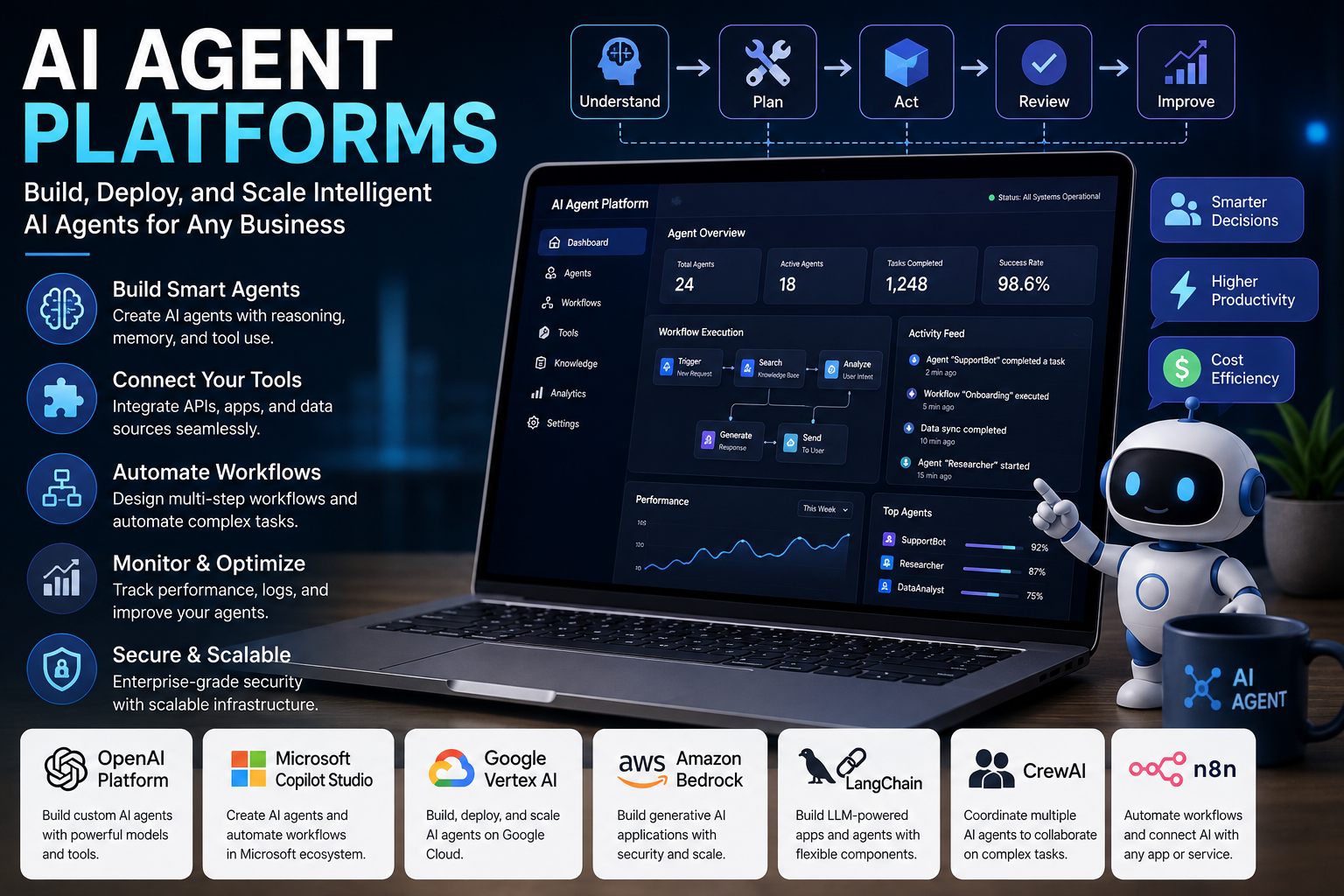
In 2026, AI agent platforms are becoming useful for software developers, marketers, business owners, and content creators. Whether you want to automate customer support or create an assistant for your website, choosing the right platform can save time and improve productivity. In this article, we explore what AI agent platforms are, how they work, their benefits, and seven popular platforms worth considering.
What Are AI Agent Platforms?
AI agent platforms are software environments that help users create and manage AI agents. An AI agent is a system that can interpret instructions, make decisions within defined limits, use connected tools, and perform tasks toward a specific goal.
Unlike a basic chatbot that mainly responds to questions, an AI agent may complete several connected steps. For example, a customer service agent could review a support request, search a knowledge base, prepare an answer, and send the response for approval.
AI agent platforms provide features such as model connections, workflow builders, integrations, memory, testing, and monitoring. Their capabilities differ depending on the product.
How Do AI Agent Platforms Work?
Most AI agent platforms combine several components to perform tasks.
1. AI Models
The language model helps an agent understand instructions, interpret information, and decide what action to take next.
2. Tools and Integrations
Agents may connect to external applications, databases, APIs, and business software to retrieve information or complete supported actions.
3. Instructions and Goals
Developers define what an agent should accomplish, which information it can use, and which actions it is permitted to perform.
4. Workflow Management
Some platforms allow users to create step-by-step workflows or coordinate multiple agents for more complex tasks.
5. Monitoring and Evaluation
Testing and monitoring help identify incorrect responses, failed actions, unexpected costs, and other problems.
Not every platform supports all these capabilities, and more advanced automation may require technical knowledge.
7 Best AI Agent Platforms to Explore in 2026
The following platforms offer different approaches to building AI agents. The best choice depends on your technical skills, budget, and project requirements.
1. OpenAI Platform
The OpenAI platform provides tools for developers building AI-powered applications and agents. Depending on the available APIs and services, developers can create systems that use models, connect tools, and perform multi-step tasks.
It can be useful for businesses developing custom assistants, support systems, research workflows, and productivity applications.
Best for: Developers who want to build customized AI-powered applications.
2. Microsoft Copilot Studio
Microsoft Copilot Studio helps organizations create AI agents and conversational experiences. It supports integrations with Microsoft’s business ecosystem and other connected services.
Businesses can use it to build internal assistants, automate selected workflows, and help employees find information.
Best for: Businesses using Microsoft products and services.
3. Google Vertex AI
Google Cloud’s Vertex AI provides infrastructure and development capabilities for building and deploying AI applications. It includes tools for working with models and developing agent-based systems.
Organizations can use it to create AI solutions connected to business data and cloud infrastructure.
Best for: Developers and organizations building cloud-based AI applications.
4. Amazon Bedrock
Amazon Bedrock provides access to supported foundation models and tools for building generative AI applications. Its agent capabilities can help developers connect models with selected data sources and business systems.
It may be suitable for companies already working within Amazon Web Services.
Best for: Businesses developing AI applications on AWS.
5. LangChain and LangGraph
LangChain offers developer tools for building applications with language models, while LangGraph focuses on controlling complex, stateful agent workflows.
Developers can use these technologies to create agents with defined steps, branching logic, and human approval processes.
They are particularly useful when a project requires more control than a simple chatbot workflow.
Best for: Developers building customized agent workflows.
6. CrewAI
CrewAI is a framework for building systems in which multiple AI agents can work on related tasks. Developers can assign agents different roles and coordinate their work toward a shared objective.
For example, a content workflow might use separate agents for research, outlining, and draft review, with a human checking the final output.
Best for: Multi-agent workflows and task coordination.
7. n8n
n8n is a workflow automation platform that supports integrations and AI-powered workflows. Users can connect different applications and create automated processes, with the option to add more advanced logic when needed.
It can help businesses connect AI capabilities to tasks such as data processing, notifications, and content operations.
Best for: Workflow automation and connecting AI with business applications.
Features, licensing, pricing, and available integrations can change, so check each platform’s official documentation before selecting a solution.
Benefits of Using AI Agent Platforms
Automate Repetitive Tasks
AI agents can assist with recurring activities such as categorizing requests, summarizing documents, and preparing routine reports. Automation frees people to focus on tasks that require judgment and creativity.
Improve Productivity
A properly configured agent can complete several connected steps without requiring a separate instruction for every small action.
Support Customer Service
Businesses can use agents to answer common questions, retrieve approved information, and direct complex requests to human support staff.
Connect Different Applications
Integration features can help agents work with selected business tools, databases, and internal systems.
Scale Business Operations
Once tested and configured, a workflow can often handle additional requests without requiring the same amount of manual effort for every task. However, higher usage may increase computing and service costs.
How to Choose the Right AI Agent Platform
Before choosing a platform, consider the following factors.
Ease of use: Beginners may prefer visual workflow builders, while developers may need programming frameworks.
Integrations: Check whether the platform supports the applications, databases, and services you already use.
Cost: Compare subscriptions, model usage, hosting, and other operational expenses.
Security: Review access controls, data handling, logging, and privacy policies.
Customization: Determine whether you can define instructions, tools, workflows, and approval requirements.
Reliability: Test how the system handles incorrect inputs, unavailable services, and unexpected situations.
Start with a small project before deploying an agent across important business operations.
How Bloggers Can Use AI Agent Platforms
AI agent platforms can help website owners organize parts of their content workflow.
For example, a blogger might build a system that collects topic ideas, groups them by subject, prepares article outlines, and adds them to a content calendar.
A more advanced workflow could connect keyword research data with a writing assistant and an editorial review process.
For CloudMagz.com, possible applications include organizing AI tool research, preparing article briefs, summarizing product documentation, and tracking content updates.
However, automated systems should not publish every generated article without review. Human editors should verify claims, add original value, check links, and ensure that content meets readers’ needs.
Are AI Agent Platforms Free?
Some platforms offer free tiers, open-source frameworks, or limited trial access. Others charge based on subscriptions, model usage, workflow executions, or cloud resources.
Open-source software may reduce licensing costs, but hosting, maintenance, development, and model usage can still require money.
Before starting a project, estimate the total cost and check the current pricing information on the platform’s official website.
Challenges and Risks of AI Agents
AI agents can be powerful, but they are not always reliable.
They may misunderstand instructions, generate inaccurate information, or select an unsuitable action. An agent connected to external applications may also change data or send messages if it has permission to do so.
To reduce risks:
- Give agents only the permissions they need.
- Test workflows with realistic examples.
- Require human approval for important actions.
- Protect private information and credentials.
- Monitor errors, usage, and unexpected behavior.
- Maintain a way to stop or reverse actions where possible.
These precautions are particularly important when agents interact with financial systems, customer records, or business-critical applications.
The Future of AI Agent Platforms
AI agent platforms are likely to continue developing as businesses explore more advanced automation. Improvements may include stronger coordination between agents, better connections to business software, improved monitoring, and more accessible tools for nontechnical users.
At the same time, successful adoption will depend on reliability, security, cost control, and responsible oversight.
Companies should focus on solving clear business problems rather than adopting agents simply because the technology is new.
Frequently Asked Questions
1. What is an AI agent platform?
It is a software environment for building, connecting, deploying, and managing AI agents that can perform tasks toward defined goals.
2. What is the best AI agent platform in 2026?
There is no single best option for every project. OpenAI, Microsoft Copilot Studio, Google Vertex AI, Amazon Bedrock, LangGraph, CrewAI, and n8n serve different needs.
3. Can beginners use AI agent platforms?
Yes. Visual workflow tools can help beginners build basic automations. More complex projects may require programming and technical knowledge.
4. Are AI agents different from chatbots?
A chatbot primarily focuses on conversation, while an AI agent may also use tools and perform multi-step actions. Some modern systems combine both capabilities.
5. Can AI agents help with SEO?
They can assist with research organization, content briefs, data processing, and editorial workflows. Human review is still necessary for factual accuracy, originality, and content quality.
Conclusion
AI agent platforms are making it easier to build intelligent assistants and automate multi-step workflows in 2026. From customer support to content planning, these tools can help individuals and businesses work more efficiently when they are configured carefully.
Compare platforms according to your needs, test them with a small project, and pay attention to security, cost, and reliability. For more guides about artificial intelligence, automation, and digital productivity, visit CloudMagz.com.
[…] publishing large amounts of generic AI-generated content is not a reliable SEO strategy. Readers need accurate information, useful explanations, and original […]