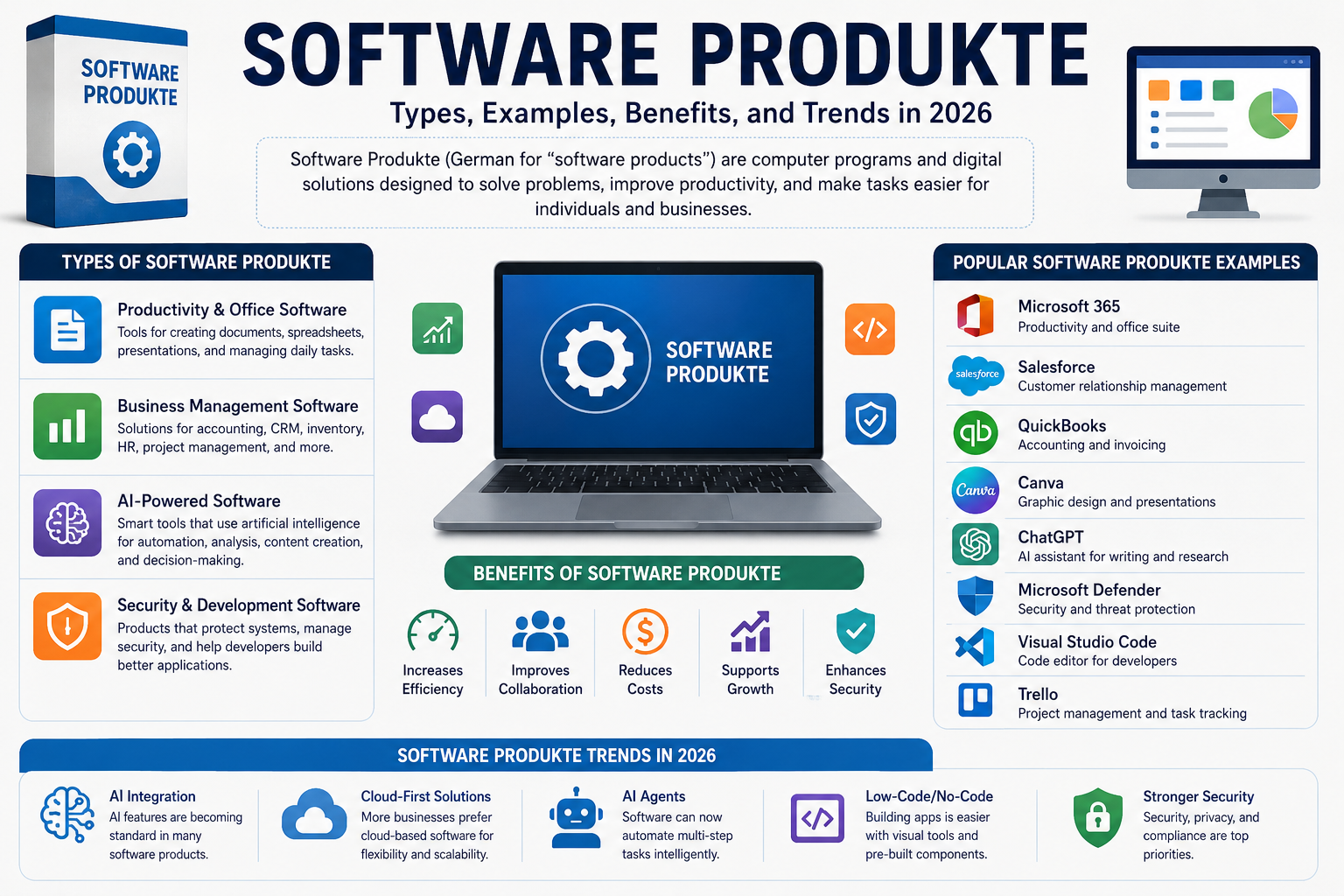
The term software produkte is German for “software products.” It refers to computer programs, applications, and digital tools designed to solve specific problems or help users complete particular tasks. These products can include mobile applications, desktop programs, cloud platforms, business management systems, AI-powered assistants, and cybersecurity solutions. According to ISO software engineering terminology, a software product can include computer programs, procedures, and associated information or data. In practical terms, it is a digital solution developed and maintained to provide value to its users.
We interact with software products almost every day, often without thinking about how much work they perform behind the scenes. When you write a document, edit a photo, send a message, manage a website, or analyze business data, you are using software products. Some are designed for millions of everyday users, while others serve specialized industries such as healthcare, finance, manufacturing, or education. Certain products are installed directly on computers and phones, whereas others run through web browsers and cloud infrastructure. Understanding these differences helps individuals and businesses choose the right digital tools for their needs.
In 2026, software products are also changing as developers integrate artificial intelligence, automation, and cloud-based services into existing applications. Businesses increasingly look for solutions that reduce repetitive work, improve customer experiences, and make information easier to use. However, choosing software should involve more than following the latest trend. Price, security, usability, compatibility, and long-term support all matter when deciding whether a product is worth adopting.
Main Types of Software Products
Software products can be grouped according to the problems they solve, the users they serve, and the technology they use. Some focus on personal productivity, while others help organizations manage customers, finances, projects, and employees. Development tools support the creation of new applications, and security products help protect devices and information. These categories often overlap because one product may offer several capabilities within a single platform. Knowing the main types makes it easier to compare alternatives and identify the most suitable solution.
1. Productivity and Office Software
Productivity software helps people create documents, organize information, prepare presentations, and collaborate with others. Popular examples include Microsoft Word, Microsoft Excel, Google Docs, and Google Sheets. These applications are useful for students preparing assignments, freelancers managing projects, and employees creating reports. Many include templates, sharing features, automatic saving, and tools that simplify routine tasks.
Modern productivity software increasingly includes AI-powered features that can help summarize information, draft content, or analyze data. Such features can save time, but users should review generated results for errors before sharing or relying on them. The best productivity product is one that fits your daily workflow, works reliably with your existing files, and offers the right balance of features and cost.
2. Business Management Software
Business software helps organizations manage their operations more efficiently. Common categories include accounting software, customer relationship management systems, inventory management applications, human resource platforms, and project management tools. Products such as Salesforce, QuickBooks, and Microsoft Dynamics 365 support different business activities, depending on the selected product and plan. Instead of keeping information scattered across spreadsheets and emails, companies can use suitable software to centralize records and coordinate work.
For small businesses, the right product can make a meaningful difference. An inventory system can help track stock, accounting software can organize invoices, and customer management tools can keep sales information in one place. However, businesses should avoid purchasing complicated platforms simply because they have many features. A focused solution that addresses the most important operational problems may provide better value than a costly system that employees struggle to use.
3. AI-Powered Software Products
AI-powered software is one of the major areas of development in 2026. These products use artificial intelligence to support tasks such as writing, research, customer service, image creation, data analysis, and programming. Examples include ChatGPT for conversational assistance, AI-enabled writing tools, intelligent analytics platforms, and coding assistants. Depending on the product, AI can help users generate a first draft, identify patterns, summarize documents, or automate parts of a workflow.
AI software can be useful for content creators, students, marketers, developers, and business owners. For example, a marketing team might use an AI tool to brainstorm campaign ideas, then edit and verify the resulting material before publication. A developer might use a coding assistant to explain a function or suggest a test case. Nevertheless, AI outputs can contain errors or misleading information, so human review remains important, especially when accuracy, privacy, or professional responsibility is involved.
4. Security and Development Software
Security software helps protect computers, networks, accounts, and business information against digital threats. Examples include antivirus tools, endpoint protection platforms, password managers, and network monitoring applications. These products can help detect suspicious activity, manage access, and reduce the risk of data loss. However, security software works best when combined with regular updates, strong passwords, multifactor authentication, and responsible user behavior.
Development software serves a different purpose: it helps programmers build and maintain digital products. Code editors, testing tools, databases, and version-control systems are commonly used throughout the software development process. For example, Visual Studio Code helps developers write code, while Git helps teams track changes and collaborate on projects. As applications become more complex, development teams increasingly combine these tools with automated testing and AI-assisted coding features.
Popular Software Product Examples
There are thousands of software products available, ranging from free tools for individuals to enterprise systems designed for large organizations. Some focus on a single task, while others combine several services into one platform. The following table highlights well-known examples and their primary uses.
| Software product | Category | Main use |
|---|---|---|
| Microsoft Word | Productivity | Writing and editing documents |
| Google Workspace | Collaboration | Documents, email, and teamwork |
| Salesforce | Business management | Customer relationship management |
| QuickBooks | Accounting | Financial records and invoicing |
| Canva | Graphic design | Creating graphics and presentations |
| ChatGPT | AI software | Writing, research, and assistance |
| Adobe Photoshop | Image editing | Editing and designing images |
| Visual Studio Code | Development | Writing and managing code |
| Microsoft Defender | Security | Device security and threat protection |
| Trello | Project management | Organizing tasks and projects |
These examples illustrate how software products support different goals. A blogger may need a content editor, an image design tool, and an SEO platform, while an online store may require inventory management, payment processing, and customer support software. Some products offer free plans with limited features, whereas others require monthly or annual subscriptions. Pricing and availability can change, so users should check the official product website before making a purchase.
Benefits of Software Products
The main advantage of software products is that they help people complete tasks more efficiently. Instead of calculating every expense manually, a business can use accounting software to organize transactions and prepare reports. Rather than managing every project through scattered messages, a team can use a project management application to assign tasks, set deadlines, and monitor progress. These tools can reduce repetitive work and make information easier to access. The result can be improved productivity, better coordination, and more time for important decisions.
Another benefit is scalability. A small business might begin with a simple invoicing tool and later adopt a broader accounting platform as its operations grow. Cloud-based products can make collaboration easier by allowing authorized users to access shared information from different locations. Software can also improve customer experiences through faster responses, online booking systems, personalized services, and better communication. However, these benefits depend on choosing suitable products and training people to use them effectively.
Software products can also support innovation. AI tools help users explore ideas, analyze information, and speed up certain creative or technical tasks. Developers can use specialized platforms to build applications, while businesses can use analytics software to understand patterns in their operations. Still, automation does not guarantee better results. Organizations should measure whether a product actually saves time, reduces errors, improves service, or generates sufficient value to justify its costs.
Software Produkte Trends in 2026
Artificial intelligence is influencing how software products are designed, marketed, and used. Deloitte’s 2026 software industry outlook describes a shift toward AI-first products, stronger competition from AI-native companies, and the growing importance of AI agents. This means software providers are increasingly looking beyond basic AI features toward products that can assist with more complete workflows.
Gartner’s September 2026 forecast estimates that worldwide spending on AI will reach approximately $2.7 trillion in 2026, representing 49.5% year-over-year growth. This figure covers AI spending across multiple markets, including infrastructure, services, and software; it is not a measure of software product sales alone. Gartner also expects AI software spending to rise, reflecting continued investment in AI capabilities and applications.
Several developments are particularly relevant to software buyers.
-
AI integration: Existing applications are adding AI features for writing, analysis, search, and automation.
-
Cloud-based delivery: More products provide online access, centralized updates, and shared collaboration.
-
AI agents: Some tools can coordinate multiple steps within a defined workflow, subject to their permissions and limitations.
-
Low-code development: Visual builders make it easier to create simple applications without writing every component manually.
-
Security and privacy: Businesses increasingly need to evaluate AI access, data handling, and third-party integrations.
These trends offer opportunities, but not every new product delivers meaningful improvements. Before adopting an AI-powered solution, users should test its reliability, understand its limitations, and compare its total cost with the benefits it provides.
How to Choose the Right Software Product
Choosing the right software product begins with identifying your actual needs. A freelancer may need affordable invoicing and project management tools, while a growing company may require customer relationship management, accounting, and reporting capabilities. Start by listing the tasks you want to improve and the features you cannot work without. Then compare products based on their usability, compatibility, pricing, security, and available support. This simple process helps prevent unnecessary spending on features you may never use.
It is also important to consider long-term value. A free product can be a good starting point, but it may have storage limits, restricted integrations, or fewer collaboration features. A paid product might save time through automation or offer stronger administrative controls. Before subscribing, review the billing terms, cancellation policy, data export options, and costs of adding more users. Whenever possible, test the product with a small project before rolling it out across your business.
Software Product Security and Common Challenges
Although software products provide many advantages, they can also create challenges. Some applications collect personal information, require extensive permissions, or depend on external services that may experience downtime. Poorly maintained software can contain vulnerabilities, while complicated interfaces may make employees less productive instead of more productive. Businesses should therefore evaluate not only what a product can do but also how safely and reliably it performs those functions.
To reduce risks, download applications from trusted sources, enable multifactor authentication, install security updates, and maintain regular backups. Businesses should review user permissions and avoid connecting unfamiliar applications to sensitive systems without proper checks. When using AI products, do not upload confidential business records or personal information unless the provider’s data policies and your organization’s rules permit it. Regular reviews help ensure that software remains useful, secure, and appropriate as requirements change.
Conclusion
Software Produkte are essential digital solutions that help individuals and businesses perform tasks, solve problems, and improve productivity. From office applications and accounting platforms to AI assistants and cybersecurity tools, software products serve many different purposes. Understanding their categories and features makes it easier to select tools that match your goals and budget.
In 2026, AI integration, cloud computing, automation, and improved security are shaping the software industry. These developments offer exciting possibilities, but buyers should evaluate products carefully rather than choosing them simply because they are popular. Focus on usability, reliability, privacy, pricing, and measurable results. By choosing the right software products, you can streamline everyday work, support business growth, and make better use of modern technology.
For more technology guides, AI tool recommendations, and software insights, explore CloudMagz.com.
Frequently Asked Questions
1. What does Software Produkte mean?
Software Produkte is a German phrase that translates to “software products” in English. It refers to applications, programs, and digital solutions created to help users complete tasks or solve specific problems.
2. What are the most common types of software products?
Common types include productivity software, business management systems, accounting applications, AI-powered tools, cybersecurity software, graphic design applications, and software development tools. Each category serves different personal or professional needs.
3. Are software products free or paid?
Software products can be free, open-source, subscription-based, or available through a one-time purchase. Some offer free basic plans and charge for advanced features, additional storage, or business functionality.
4. What are the latest software product trends in 2026?
Major trends include AI-powered applications, AI agents, cloud-based software, low-code development, workflow automation, and stronger cybersecurity. Businesses are increasingly evaluating these technologies for their practical value and potential risks.
5. How can I choose the best software product for my business?
Identify your main requirements, set a budget, compare available features, check security and compatibility, and test shortlisted products. Choose the solution that offers the best combination of reliability, usability, support, and long-term value.
[…] in application packaging requires both technical knowledge and problem-solving abilities. While many professionals start with desktop support or system […]