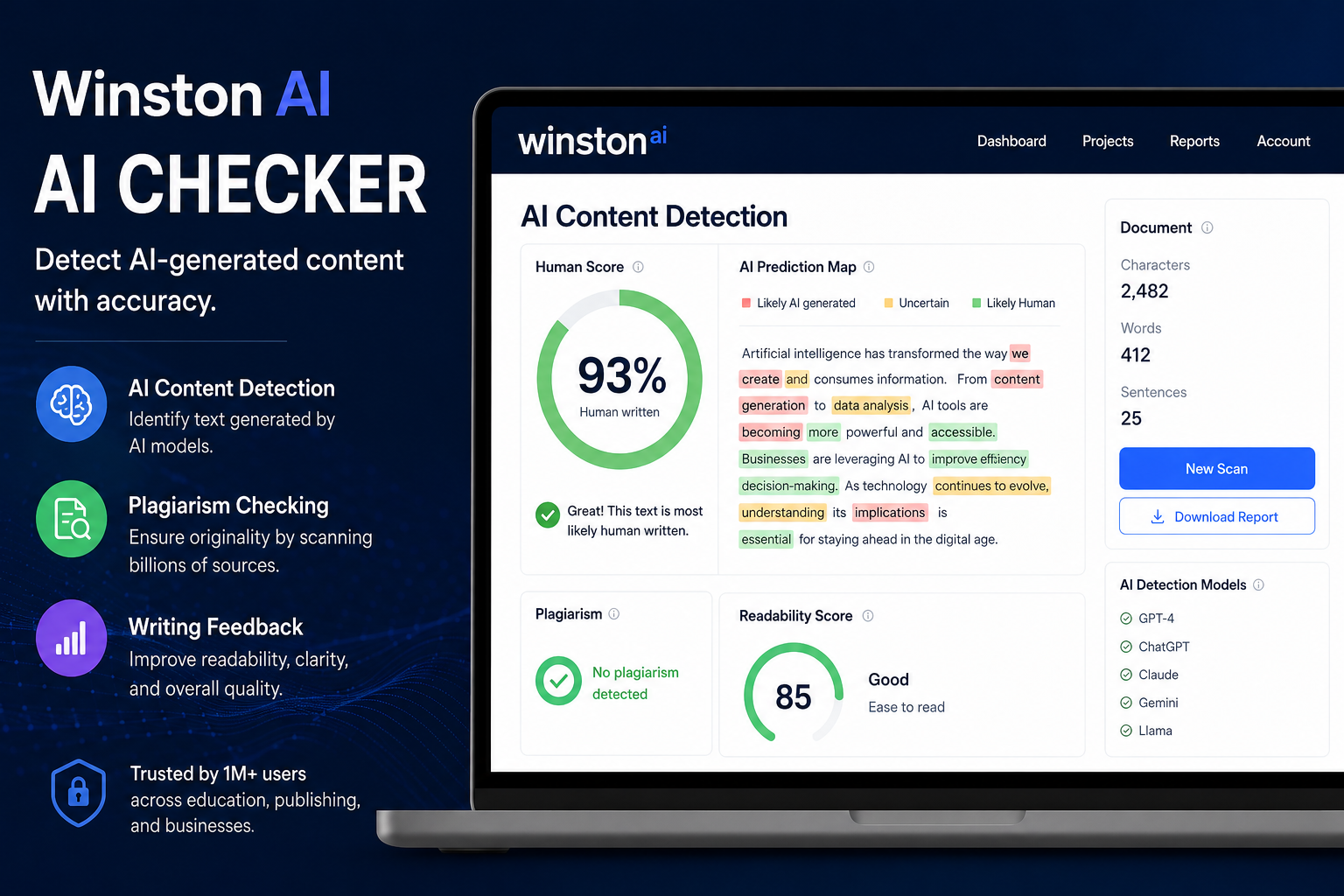
The Winston AI AI checker is an online content analysis tool designed to identify text that may have been generated by artificial intelligence. It helps writers, bloggers, teachers, publishers, and businesses evaluate written material before using or publishing it. As AI writing tools become more common, checking the origin and originality of content has become an important part of many writing workflows. Winston AI combines AI detection with additional features, including plagiarism checking, writing feedback, and document analysis, depending on the selected plan.
Unlike a traditional grammar checker, which focuses on spelling, punctuation, and sentence structure, Winston AI examines patterns in text that may be associated with AI-generated writing. It provides a Human Score and a sentence-level AI Prediction Map to help users understand its assessment. The company says its technology supports detection across several major AI models, including ChatGPT, Claude, and Google Gemini. However, detection scores are estimates rather than definitive proof of who wrote a document. You can explore the platform at the official Winston AI website.
How Does Winston AI Work?
The Winston AI AI checker analyzes the text submitted by a user and looks for linguistic patterns associated with machine-generated content. Depending on the text and the detector’s capabilities, these patterns may include predictable phrasing, sentence structures, and other statistical characteristics. The tool then generates a result intended to indicate whether the writing appears more consistent with human writing or AI-generated text.
Users can review the overall Human Score and examine the AI Prediction Map for individual sentences. The platform also offers other analysis options, such as plagiarism checking and writing feedback, on supported plans.
It is important to understand that an AI detector does not observe the writing process itself. It cannot independently confirm whether someone used an AI assistant, edited a generated draft, or wrote every sentence manually. Human writers may use predictable language, while AI-generated writing can be heavily revised. For this reason, Winston AI is most useful as one source of evidence in a broader content review, not as the final authority on authorship.
Key Features of Winston AI
AI Content Detection
The main feature of Winston AI is its AI content detector. It is designed to evaluate text that may have been produced by popular generative AI systems. This can help editors and publishers identify passages that deserve closer review before publication. Its Human Score provides an overall assessment, while the AI Prediction Map highlights individual sentences that the detector considers more or less likely to be AI-generated.
For example, a blogger preparing an article for CloudMagz.com could scan a draft to examine how the detector classifies its writing. If some paragraphs receive an unexpected result, the blogger can review those sections for repetitive language, weak explanations, unsupported claims, or an overly uniform writing style. The purpose should be to improve clarity and editorial quality, rather than simply chasing a particular detection percentage.
Plagiarism Checking
Winston AI also offers plagiarism detection on eligible plans. This feature serves a different purpose from AI detection: it looks for similarities between submitted content and existing material. AI detection evaluates writing patterns, whereas plagiarism checking investigates whether text may overlap with other published sources. Using both tools can therefore provide a more complete content review.
This distinction matters for website owners who publish informational articles. A passage can be AI-generated without copying a specific source, and a human-written passage can contain copied material. Neither result automatically establishes the other. Before publishing an article, check factual claims, cite appropriate sources, and ensure that any borrowed ideas or quotations are properly attributed. A plagiarism score should also be reviewed in context because common phrases and properly quoted material can produce matches.
Writing Feedback and Readability
Depending on the subscription, Winston AI provides writing feedback and readability-related analysis. These features can help users identify areas where their content may benefit from clearer sentences, better organization, or more effective wording. Such feedback is particularly useful when preparing long articles, academic drafts, and business documents.
For SEO writers, readability matters because visitors need to understand the information quickly. Consider a paragraph filled with repeated keywords and generic claims. Instead of making random changes to influence a detector, a writer can add a concrete example, explain the subject more clearly, and remove unnecessary repetition. The result is more useful to readers regardless of the detector’s score. Available analysis features and credit requirements should be checked against the current Winston AI
How to Use Winston AI Step by Step
Using the Winston AI AI checker is relatively straightforward, even if you have never used an AI detection tool before. The platform provides a text-scanning workflow that allows you to submit content, select analysis features, and review the results. According to its help documentation, pasted text must contain at least 500 characters, and additional ways of submitting content may be available depending on the workflow.
Follow these steps to get started:
-
Open the website: Visit Winston AI and create an account or sign in.
-
Start a new scan: Open the text-scanning interface from your dashboard.
-
Add your content: Paste your article into the editor or use a supported document-upload option.
-
Choose your analysis: Select AI detection and any additional tools available with your plan.
-
Run the scan: Review the estimated Human Score and sentence-level results.
-
Evaluate the findings: Check highlighted passages, factual accuracy, originality, and writing quality before making revisions.
The most important step comes after the scan. Do not automatically rewrite every sentence flagged by the detector. Read the highlighted passages and ask whether they are clear, accurate, specific, and useful. If a paragraph makes a broad claim without evidence, improve the explanation and add a reliable source where appropriate. If it repeats the same point several times, remove the unnecessary wording. This process improves the actual article instead of focusing entirely on a numerical score.
Winston AI Pricing and Plans
Winston AI offers a free trial and several paid subscriptions. Its official pricing page lists different credit allowances according to the selected plan, with additional features available at higher levels. Prices may change, so check the live pricing page before purchasing.
| Plan | Standard listed price | Monthly credits |
|---|---|---|
| Free trial | $0 | 2,000 credits for 14 days |
| Essential | $18/month | 100,000 |
| Advanced | $29/month | 200,000 |
| Elite | $49/month | 500,000 |
Prices shown are standard monthly-billing rates from the official pricing information checked for this article. Promotions and annual billing can change the effective cost.
The free trial is useful for testing the interface and deciding whether its results suit your workflow. Essential may be suitable for individual users who primarily need AI detection and writing feedback. Advanced offers a larger credit allowance and additional features, while Elite is intended for higher-volume use and larger teams. The right choice depends on how much content you scan, whether you need plagiarism checking, and whether you work alone or collaborate with others.
Remember that credits are consumed when you run scans and certain other analysis features. Review the current credit rules before scanning large documents, particularly if you plan to use several tools on the same article.
Benefits of Winston AI
One of the biggest advantages of Winston AI is that it brings several content-review functions together. Instead of evaluating only the possibility of AI-generated writing, users can access additional tools for originality and writing quality, subject to their subscription. This can be helpful for bloggers, publishers, educators, and businesses that review a high volume of written material.
Another benefit is the detailed presentation of results. An overall score gives users a quick overview, while sentence-level highlighting can help them identify sections that deserve further attention. The platform also supports document scanning and shareable reports on eligible plans, which can be useful for teams that need to document their review process.
For website owners, the greatest value may come from using the checker as part of a wider editorial process. A quality article should answer the reader’s question, offer accurate information, use relevant examples, and avoid unnecessary repetition. Winston AI can contribute to content review, but human editing and fact-checking remain essential. A strong article should be valuable even if no AI detector is ever used on it.
Limitations and Accuracy of Winston AI
Although Winston AI publishes encouraging accuracy results, it is important to interpret those claims carefully. Its official research library reports strong performance on selected evaluations, including results from the RAID benchmark and a Chicago Booth document comparison. Independent studies have also evaluated Winston AI, but findings depend on the datasets, text types, and methods used in each study.
A result from a controlled benchmark does not guarantee the same accuracy for every blog post, school assignment, translated article, or heavily edited document. Short text samples provide less evidence for classification, and unusual writing styles may produce misleading results. Even the tool’s own guidance recommends treating detection scores as evidence to review rather than an automatic verdict.
For these reasons, Winston AI should not be used alone to accuse a student of misconduct or question a writer’s integrity. If a result is unexpected, consider the document’s writing history, original notes, references, and revision records. The most responsible approach is to combine the detector’s output with human judgment and other relevant evidence.
Winston AI vs. Other AI Checkers
Several AI detection tools are available, and each may suit a different workflow. Winston AI focuses on AI detection alongside plagiarism and writing analysis. Other services may emphasize sentence classification, educational integrity, or integrations with writing platforms.
| Feature | Winston AI | Other AI checkers |
|---|---|---|
| AI-generated text detection | Yes | Common feature |
| Sentence-level analysis | Yes | Depends on tool |
| Plagiarism detection | Available on eligible plans | Varies |
| Writing feedback | Available on eligible plans | Varies |
| Free access | Limited trial | Depends on provider |
| Best choice | Depends on your needs | Compare individual features |
Winston AI is worth testing if you want several content-review functions in one place. However, compare tools using the same writing samples, and do not assume that one detector is always more reliable than another. Different systems can produce different classifications for the same document.
Who Should Use Winston AI?
Winston AI may be useful for bloggers, SEO content writers, teachers, editors, publishers, and marketing teams. Bloggers can review drafts, educators can examine submitted work as part of a broader assessment, and publishers can use the tool to support their editorial procedures.
For CloudMagz.com, it could be one part of a content-quality workflow. Writers can use it to review articles while separately checking facts, originality, keyword relevance, and readability. The goal should be to publish helpful content that answers readers’ questions rather than producing articles solely to satisfy an AI detector.
Conclusion
The Winston AI AI checker is a useful content-analysis platform for people who want to evaluate potentially AI-generated writing, review plagiarism, and improve their editorial workflow. Its sentence-level analysis, Human Score, and additional writing tools make it worth exploring for bloggers and professional content teams.
However, no detection result should be treated as absolute proof of authorship. Accuracy varies according to the text and testing conditions, and false positives remain possible. Start with the free trial, evaluate the results against your own writing samples, and consider a paid plan only if the features meet your needs. Most importantly, prioritize accurate, original, reader-focused content over any single detection score.
Frequently Asked Questions (FAQs)
1. What is the Winston AI AI checker?
It is an online tool that analyzes text for patterns associated with AI-generated writing. It also offers additional content-analysis features, including plagiarism checking and writing feedback on supported plans.
2. Is Winston AI free?
Winston AI offers a free trial with 2,000 credits for 14 days. Continued access to additional features and higher credit allowances requires a suitable paid plan. Check the official website for current terms.
3. Can Winston AI detect ChatGPT content?
Winston AI is designed to detect AI-generated text from ChatGPT and other major AI models. However, results are estimates and should not be considered definitive proof of how a document was written.
4. Is Winston AI accurate?
The company reports strong results on selected benchmarks, and independent studies have evaluated its performance. Actual results can vary depending on text length, writing style, document type, and evaluation methods.
5. Is Winston AI useful for SEO articles?
Yes. SEO writers can use Winston AI as one part of their editorial process. They should also verify factual claims, check originality, improve readability, and ensure their content provides genuine value to readers.
editer. cloudmagz