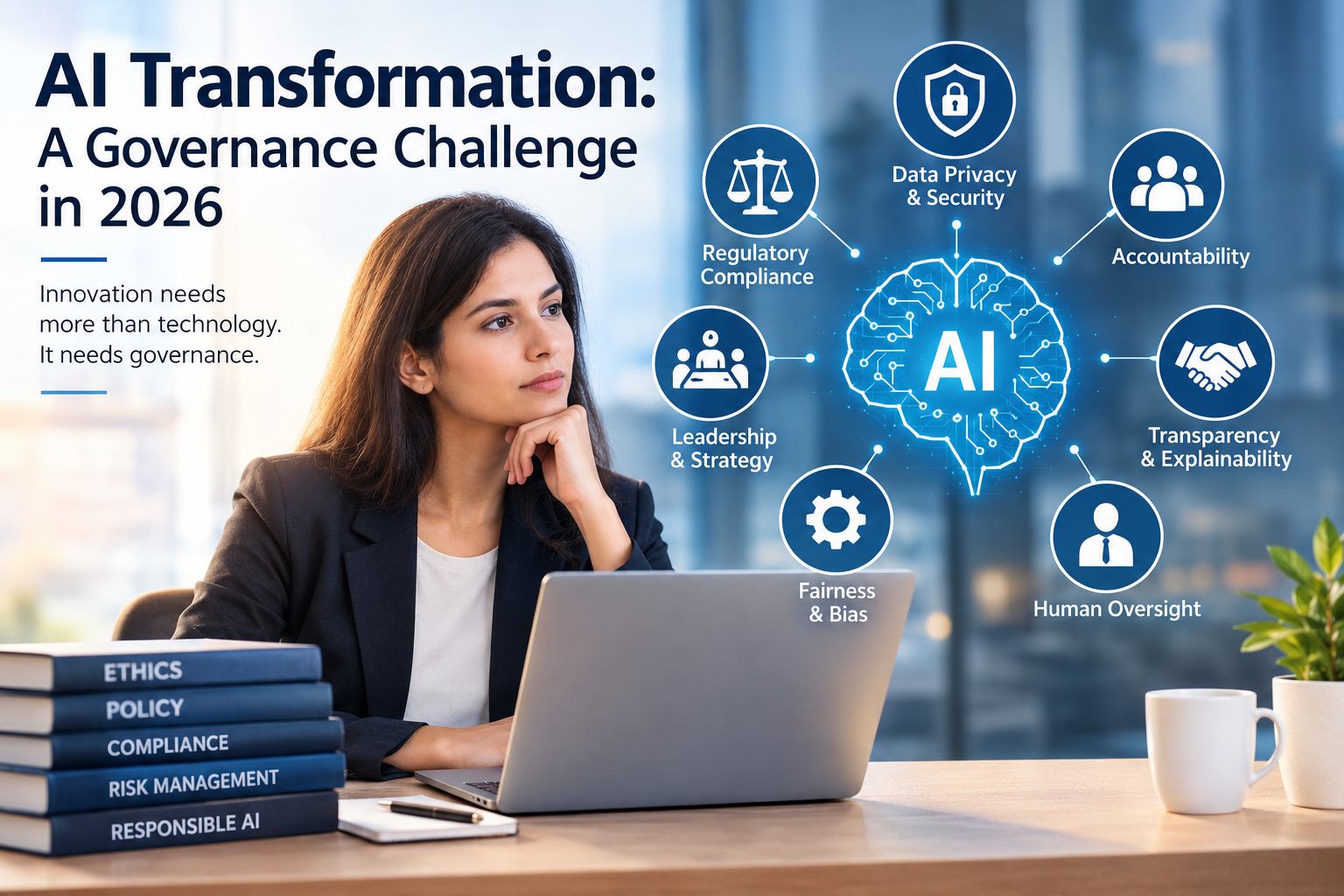
Artificial intelligence (AI) is transforming businesses, education, healthcare, finance, and many other industries. Companies are using AI tools to automate tasks, analyze data, improve customer experiences, and make faster decisions. However, adopting AI successfully requires more than advanced technology. Organizations must also establish clear rules, responsibilities, and policies to manage how AI systems are developed and used. This is why AI transformation is a problem of governance, not simply a technical challenge.
Without effective governance, businesses may face data privacy problems, security risks, biased decisions, regulatory challenges, and a lack of accountability. In 2026, responsible AI adoption requires organizations to balance innovation with transparency, safety, and human oversight. Understanding AI governance can help businesses use artificial intelligence more effectively while protecting customers, employees, and other stakeholders.
What Does AI Transformation Is a Problem of Governance Mean?
AI Transformation Is a Problem of Governance refers to the process of integrating artificial intelligence into an organization’s operations, products, services, and decision-making processes.
It can involve introducing AI-powered customer support, automating administrative work, using machine learning to identify patterns, or applying generative AI to content creation and research.
For example, a company might use an AI assistant to answer customer questions. Another organization might use machine learning to forecast demand or identify unusual financial transactions.
These applications can improve efficiency, but they also introduce new responsibilities. Organizations need to decide what data AI systems can access, who can approve their use, how their results should be checked, and what happens when they make mistakes.
These decisions are central to AI governance.
Why AI Transformation Is a Problem of Governance Is a Problem of Governance
AI Transformation Is a Problem of Governance is often discussed as a technology project. Businesses may focus on selecting software, purchasing subscriptions, hiring developers, or integrating AI into existing systems.
However, technology alone cannot determine whether an AI application is fair, secure, legal, or appropriate for a particular purpose.
Governance establishes the structure within which AI technology operates.
It defines who makes decisions, who is accountable for outcomes, which risks are acceptable, and how organizations monitor AI systems after deployment.
For example, an AI hiring tool might help recruiters review applications more quickly. Without proper governance, however, the system could disadvantage certain candidates because of biased training data or poorly designed evaluation criteria.
An effective governance framework would require appropriate testing, human review, documentation, and a process for addressing complaints.
This example demonstrates why successful AI Transformation Is a Problem of Governance depends on organizational leadership and accountability as much as technical capability.
1. Data Privacy and Security
One of the biggest governance challenges in AI Transformation Is a Problem of Governance is protecting sensitive information.
AI systems may process customer records, employee information, business documents, financial data, or confidential communications. If organizations handle this information incorrectly, they can expose individuals and businesses to significant risks.
Employees might unknowingly paste confidential information into an unapproved AI chatbot. A poorly secured application might expose internal documents or retain information longer than intended.
Organizations should establish clear policies explaining which AI tools employees can use and what information they are allowed to share.
Important safeguards include:
- Classifying sensitive and confidential information.
- Limiting access to authorized users.
- Reviewing the privacy and security practices of AI vendors.
- Applying appropriate data retention policies.
- Training employees to recognize potential data exposure risks.
- Establishing procedures for reporting and responding to incidents.
Good governance makes data protection part of the AI adoption process rather than an afterthought.
2. Accountability for AI Decisions
Another reason AI Transformation Is a Problem of Governance is a governance problem is the question of accountability.
When an AI system produces an incorrect recommendation or harmful result, organizations must determine who is responsible for investigating and correcting the issue.
Responsibility should not disappear simply because a decision involved an algorithm.
For example, an AI system used by a financial institution might incorrectly flag a legitimate transaction as suspicious. The organization needs a clear process for reviewing the decision, correcting errors, and informing affected customers when appropriate.
Businesses should assign responsibility for AI systems to specific teams or individuals. Depending on the application, these responsibilities may involve management, legal teams, cybersecurity specialists, data scientists, and operational staff.
Clear accountability helps ensure that AI systems are monitored and that problems receive timely attention.
3. Bias and Fairness in Artificial Intelligence
AI systems learn patterns from data and other information used during their development. If that information contains historical bias or does not adequately represent the people affected by the system, the resulting decisions may be unfair.
This issue is particularly important in recruitment, lending, healthcare, education, and other areas where automated decisions can significantly affect people’s lives.
For example, an AI recruitment system trained on biased historical hiring records could reproduce patterns that disadvantage qualified candidates.
Organizations should test AI systems for unfair outcomes before deployment and continue monitoring them as conditions change.
Governance measures can include diverse testing datasets, documented evaluation criteria, independent reviews, and meaningful human oversight.
Fairness cannot always be reduced to a single mathematical score. Organizations must consider the context, potential impact, and people affected by each application.
4. Transparency and Explainability
AI systems can sometimes produce results that are difficult for users to understand. This creates challenges when people need to know why a recommendation or decision was made.
Transparency helps organizations explain how AI is being used, what its limitations are, and when human involvement is necessary.
For example, a university using AI to support student assessment should communicate the role of the system and explain how students can request a review of disputed results.
Businesses should document important AI applications, explain their intended purposes, and communicate relevant limitations to users.
The level of explanation required depends on the risk involved. A low-risk tool that suggests email subject lines may need fewer controls than a system that influences medical treatment or access to financial services.
5. Regulatory Compliance and Legal Responsibilities
AI governance also involves understanding applicable laws, regulations, contractual obligations, and industry standards.
Requirements differ by country, industry, and type of AI application. Organizations operating internationally may need to comply with multiple regulatory frameworks.
For example, the European Union’s AI Act establishes a risk-based regulatory framework with requirements that vary according to the AI system and its intended use. Some provisions have phased application dates, so organizations should check the current requirements relevant to their activities.
Businesses may also need to consider privacy laws, consumer protection rules, employment regulations, intellectual property issues, and cybersecurity obligations.
A practical compliance program should identify applicable requirements, assign responsibility for meeting them, maintain appropriate documentation, and review changes in the regulatory environment.
Companies should obtain qualified legal advice when AI applications create significant legal or regulatory risks.
6. Human Oversight in AI Transformation Is a Problem of Governance
AI can process large amounts of information quickly, but it can still produce inaccurate, incomplete, or misleading results.
Human oversight helps organizations identify these problems and prevent excessive reliance on automated outputs.
For example, a medical professional may use AI to summarize patient information, but clinical decisions should follow appropriate professional standards and applicable requirements.
Similarly, a business manager might use AI-generated forecasts to support planning while considering market conditions, operational knowledge, and other relevant evidence.
Organizations should determine which decisions require human approval, which tasks can be automated safely, and when employees must intervene.
Human oversight should be meaningful. Employees need sufficient knowledge, authority, and time to question AI recommendations rather than automatically accepting them.
7. The Role of Leadership in AI Governance
Successful AI Transformation Is a Problem of Governance requires leadership involvement.
Executives and managers must connect AI initiatives with business objectives, establish acceptable risk levels, and ensure that appropriate resources are available.
Without leadership support, different departments may adopt incompatible tools, duplicate spending, or introduce AI systems without adequate security reviews.
Leaders should develop a clear AI strategy that identifies priorities, responsibilities, and measurable outcomes.
They should also encourage collaboration between technical teams and business departments. AI governance is not solely the responsibility of IT because AI can influence customer relationships, employment practices, financial decisions, and organizational reputation.
A cross-functional governance team can help coordinate these responsibilities and ensure consistent standards across the organization.
8. How Businesses Can Build an Effective AI Governance Framework
Organizations do not need to solve every governance challenge at once. They can begin with a practical framework and improve it as their AI use develops.
Step 1: Identify Existing AI Systems
Create an inventory of AI tools and applications currently used across the organization. Include officially approved systems and relevant employee use of third-party tools.
Step 2: Assess Risks
Evaluate each application according to its purpose, data access, potential harm, level of automation, and effect on people.
A tool that summarizes public documents presents different risks from a system that influences hiring or lending decisions.
Step 3: Establish Clear Policies
Define acceptable AI use, data protection requirements, review procedures, and prohibited activities. Make the policies understandable to employees.
Step 4: Assign Responsibility
Identify who approves AI applications, monitors performance, reviews incidents, and ensures compliance.
Step 5: Test Before Deployment
Assess accuracy, security, reliability, fairness, and suitability for the intended purpose. Record important limitations and unresolved risks.
Step 6: Monitor Performance
AI systems can behave differently when data, user behavior, or operating conditions change. Review performance regularly and investigate unexpected results.
Step 7: Train Employees
Teach employees how to use AI responsibly, verify outputs, protect confidential information, and report problems.
Step 8: Review and Improve
Update governance policies as technology, organizational needs, and legal requirements evolve.
This process helps businesses make AI governance an ongoing management responsibility rather than a one-time approval exercise.
9. Benefits of Responsible AI Governance
Although governance requires time and investment, it can create meaningful business benefits.
Reduced risk: Clear policies and appropriate controls can reduce the likelihood of data breaches, harmful decisions, and operational failures.
Greater trust: Customers and employees may feel more confident when organizations explain how AI is used and how concerns can be addressed.
Better decision-making: Human review and quality testing can help organizations identify unreliable AI outputs before they cause serious problems.
More consistent adoption: Shared standards help departments use AI tools in a coordinated and secure way.
Improved long-term value: Governance helps organizations evaluate whether AI systems deliver meaningful results instead of adopting technology simply because it is popular.
Responsible governance does not eliminate every risk, but it provides a structured way to identify, manage, and respond to problems.
10. The Future of AI Governance in 2026 and Beyond
As AI capabilities expand, governance will become increasingly important for organizations of different sizes.
Businesses are exploring AI agents that can complete multiple tasks, interact with software systems, and perform workflows with limited human intervention. These applications create new questions about permissions, monitoring, accountability, and the limits of autonomous action.
Organizations will need stronger controls over what AI agents can access, which actions they can perform, and when human approval is required.
Governance will also need to adapt to more complex AI supply chains, including third-party models, external data providers, and integrated business applications.
In the coming years, organizations that combine responsible governance with practical innovation may be better positioned to build trust and use AI sustainably.
The objective should not be to prevent innovation. It should be to make innovation reliable, secure, accountable, and aligned with human needs.
Frequently Asked Questions
1. Why is AI Transformation Is a Problem of Governance a problem of governance?
AI transformation requires decisions about accountability, privacy, security, fairness, compliance, and human oversight. These are organizational governance issues, not just technical challenges.
2. What is AI governance?
AI governance is the collection of policies, responsibilities, processes, and controls used to guide the development, deployment, and use of artificial intelligence.
3. Who is responsible for AI governance?
Responsibility is shared across organizational leadership, technical teams, legal and compliance specialists, security professionals, and employees who use AI. Specific responsibilities should be clearly assigned.
4. Can small businesses implement AI governance?
Yes. Small businesses can start with simple approved-tool lists, data protection rules, employee training, risk assessments, and human review of important AI-generated decisions.
5. Does AI governance slow innovation?
Well-designed governance can help innovation by clarifying acceptable risks, reducing uncertainty, and making it easier to approve suitable AI applications. Excessively complicated processes, however, can create unnecessary delays.
6. What are the biggest AI governance risks?
Common risks include privacy violations, security weaknesses, biased outputs, inaccurate information, unclear accountability, regulatory noncompliance, and excessive dependence on automated decisions.
Conclusion
AI Transformation Is a Problem of Governance is a problem of governance because successful AI adoption requires more than advanced tools and technical expertise. Organizations must establish clear responsibilities, protect sensitive information, manage risks, monitor performance, and maintain appropriate human oversight.
In 2026, businesses that treat AI governance as a core part of their strategy can make more informed decisions about where and how to use artificial intelligence. A structured approach helps organizations balance innovation with accountability, security, fairness, and trust.
Ultimately, the goal is not simply to adopt AI faster. It is to use AI responsibly and effectively in ways that create lasting value for organizations, customers, employees, and society.
editer cloudmagz.com
[…] should also avoid assuming that an AI-generated statement is automatically true. A structured record can still contain incorrect information if its source is […]