
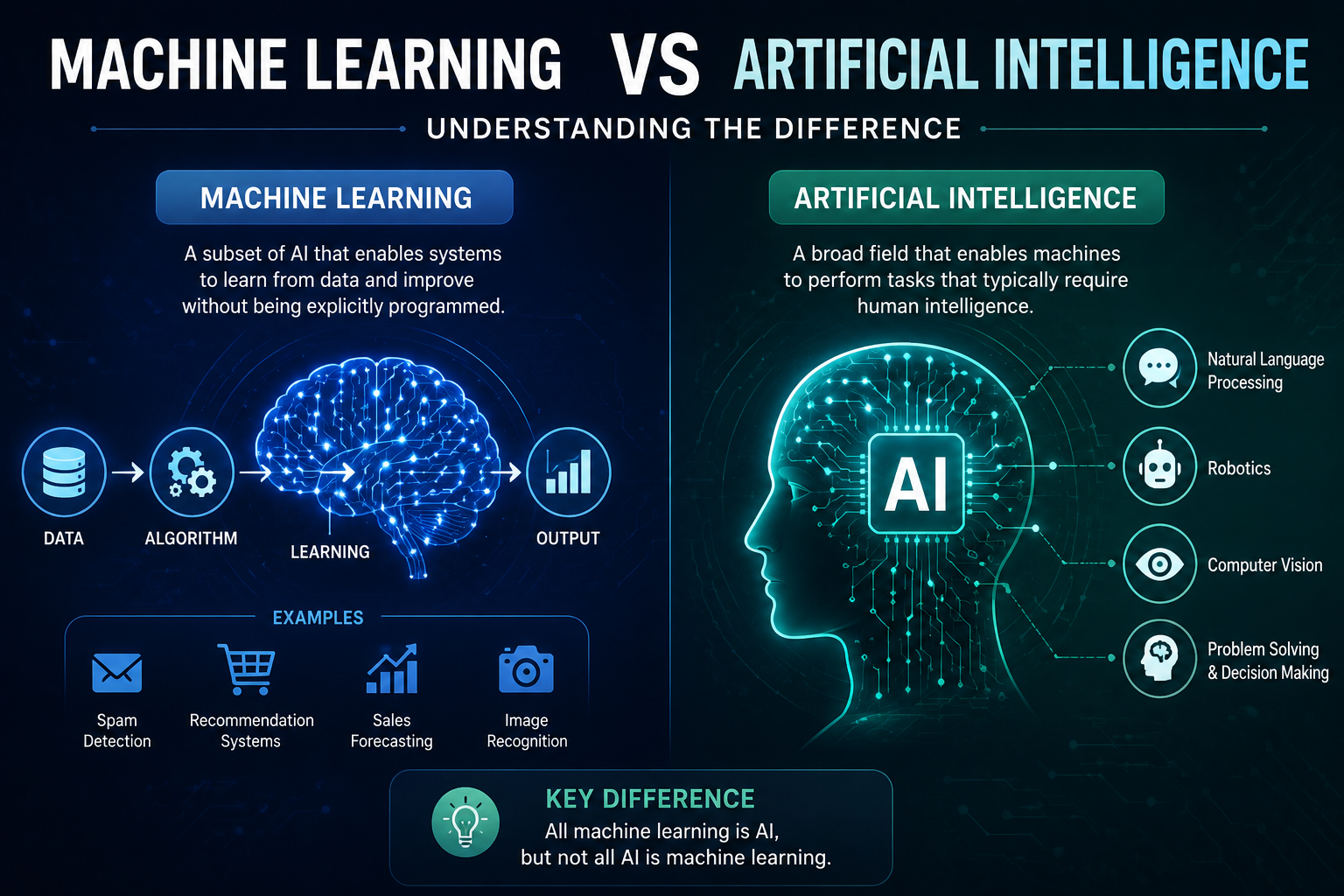
Artificial intelligence and machine learning are two of the most discussed technologies in the modern digital world. They are often used interchangeably, but they do not mean exactly the same thing.
Artificial intelligence, commonly known as AI, is a broad field focused on creating systems that can perform tasks associated with human intelligence. Machine learning, or ML, is one of the key technologies used to build many modern AI systems.
Understanding the difference between machine learning and artificial intelligence can make it easier to understand how technologies such as recommendation systems, virtual assistants, fraud detection tools, and generative AI work.
What Is Artificial Intelligence?
Artificial intelligence is the broader concept of creating computer systems that can perform tasks that typically require human intelligence.
These tasks may include understanding language, recognizing images, solving problems, making predictions, planning actions, and assisting with decisions.
AI systems can be designed for many different purposes. Some are built to perform a single specialized task, while more advanced systems can handle a wider range of activities.
Examples of AI applications include:
- Virtual assistants
- Recommendation systems
- Image recognition
- Fraud detection
- Automated customer support
- Language processing
- Generative AI tools
- Autonomous technologies
The important point is that AI is an overall field, while machine learning is one of the major approaches used within that field.
What Is Machine Learning?
Machine learning is a branch of artificial intelligence that allows computer systems to learn patterns from data and use those patterns to make predictions or decisions.
Traditional computer programs generally rely on explicitly defined rules. In machine learning, developers can instead train a model using data so that the system can identify patterns and improve its performance on a particular task.
For example, a company could train a machine learning model using historical transactions to identify patterns associated with potentially fraudulent activity.
The model does not simply follow one fixed rule. It learns statistical patterns from the available training data and uses those patterns when processing new information.
AI vs Machine Learning: The Main Difference
The simplest way to understand the relationship is:
Artificial intelligence is a broad field focused on creating systems capable of intelligent behavior. To understand the different categories and capabilities of AI, explore the types of artificial intelligence.
AI focuses on the larger goal of developing systems capable of intelligent behavior.
Machine learning focuses on enabling systems to learn from data and improve their performance without requiring every possible rule to be manually programmed.
This means:
AI → Broad field of intelligent computer systems
Machine Learning → A major technique used to build AI systems
Not every AI system necessarily depends on machine learning, although machine learning has become one of the most important technologies in modern AI development.
How Machine Learning Works
A typical machine learning process involves several important stages.
1. Collecting Data
Machine learning systems require relevant data for training. Depending on the application, this could include text, images, numbers, audio, transactions, or other types of information.
The quality and relevance of the data can have a significant impact on the resulting model.
2. Training a Model
During training, a machine learning algorithm analyzes available data and identifies patterns or relationships.
For supervised learning, the training data may include known answers. The model learns to associate input information with the expected output.
3. Testing and Evaluation
After training, the model needs to be evaluated using data that was not used during training.
This helps developers understand how well the system performs when it encounters new information.
4. Making Predictions
Once a model is sufficiently trained, it can process new data and generate predictions, classifications, recommendations, or other outputs.
For example, a trained model could analyze an email and estimate whether it is likely to be spam.
Different Types of Machine Learning
Machine learning is not a single technique. Several approaches are used depending on the problem.
Supervised Learning
Supervised learning uses labeled training data. The model learns from examples where the expected result is already known.
Common applications include classification, forecasting, and prediction.
Unsupervised Learning
Unsupervised learning works with data that does not have predefined labels.
The system attempts to discover patterns, groups, or structures within the data.
Businesses can use this approach for activities such as customer segmentation and exploratory data analysis.
Reinforcement Learning
Reinforcement learning involves an agent interacting with an environment and receiving feedback based on its actions.
Over time, the system learns strategies that can help it achieve a particular objective.
This approach has been used in areas such as robotics, games, and optimization problems.
How AI and Machine Learning Are Used in Everyday Life
Many people interact with AI and machine learning without realizing it.
Search Engines
Search engines use sophisticated algorithms and machine learning techniques to understand queries and provide relevant results.
Streaming Recommendations
Video and music platforms can analyze viewing or listening behavior to recommend content that may be relevant to individual users.
Online Shopping
E-commerce platforms can use AI and machine learning to personalize recommendations, identify purchasing patterns, and improve search results.
Fraud Detection
Financial institutions can analyze transaction patterns to identify unusual activity and potentially detect fraudulent transactions.
Voice Assistants
Voice-based systems can use speech recognition, natural language processing, and machine learning to understand spoken commands.
Generative AI
Modern generative AI systems can produce text, images, audio, code, and other forms of content based on user instructions.
Many of these systems rely heavily on machine learning and large-scale neural network architectures.
Is Machine Learning the Same as Deep Learning?
No.
Deep learning is a specialized area within machine learning.
It uses artificial neural networks with multiple layers to process complex patterns. Deep learning has become particularly important for applications involving images, speech, language, and large-scale generative AI.
The relationship can be simplified as:
Artificial Intelligence → Machine Learning → Deep Learning
Each level represents a more specific area within the broader technology landscape.
Why the Difference Matters for Businesses
Understanding these terms is useful for businesses considering AI technologies.
A company may say that it wants to “use AI,” but the actual technology required depends on the problem it wants to solve.
For example, a business might need machine learning for demand forecasting, natural language processing for customer support, or a generative AI system for drafting content.
Choosing the right technology begins with understanding the business problem rather than simply selecting the latest AI tool.
Benefits of Machine Learning and AI
Both technologies can provide significant advantages when implemented appropriately.
Automation
AI-powered systems can assist with repetitive and time-consuming tasks.
Faster Analysis
Machine learning can process large datasets and identify patterns that may be difficult to discover manually.
Personalization
AI can help businesses deliver more personalized recommendations and experiences.
Improved Efficiency
Automation and intelligent software can streamline workflows and reduce unnecessary manual effort.
Better Insights
Machine learning models can help organizations identify trends and make predictions based on historical information.
Limitations and Challenges
AI and machine learning also have limitations.
The performance of a machine learning model depends heavily on the quality of the data used to train it. Poor-quality, incomplete, or biased data can produce unreliable results.
AI systems can also make mistakes. An output that appears convincing is not necessarily accurate, which is why human review remains important for many applications.
Businesses also need to consider privacy, security, transparency, cost, and responsible use when implementing AI technologies.
What Is the Future of AI and Machine Learning?
AI and machine learning are expected to become increasingly integrated into software, business processes, consumer applications, and professional workflows.
As computing infrastructure and AI models continue to evolve, these technologies may become easier for organizations of different sizes to adopt.
The future is unlikely to be defined by AI alone. Human expertise will remain important for setting goals, evaluating results, managing risks, and making decisions.
The most useful approach may be a combination of human judgment and machine intelligence, where technology handles complex information and repetitive tasks while people provide context, creativity, and accountability.
Final Thoughts
Artificial intelligence and machine learning are closely connected, but they are not identical.
AI is the broader field concerned with creating systems capable of intelligent behavior, while machine learning is a major approach that allows computers to learn patterns from data.
Understanding this distinction helps businesses, professionals, and everyday technology users better understand the systems they interact with.
As AI continues to develop, knowing the fundamentals of AI, machine learning, and deep learning will become increasingly valuable in a technology-driven world.