
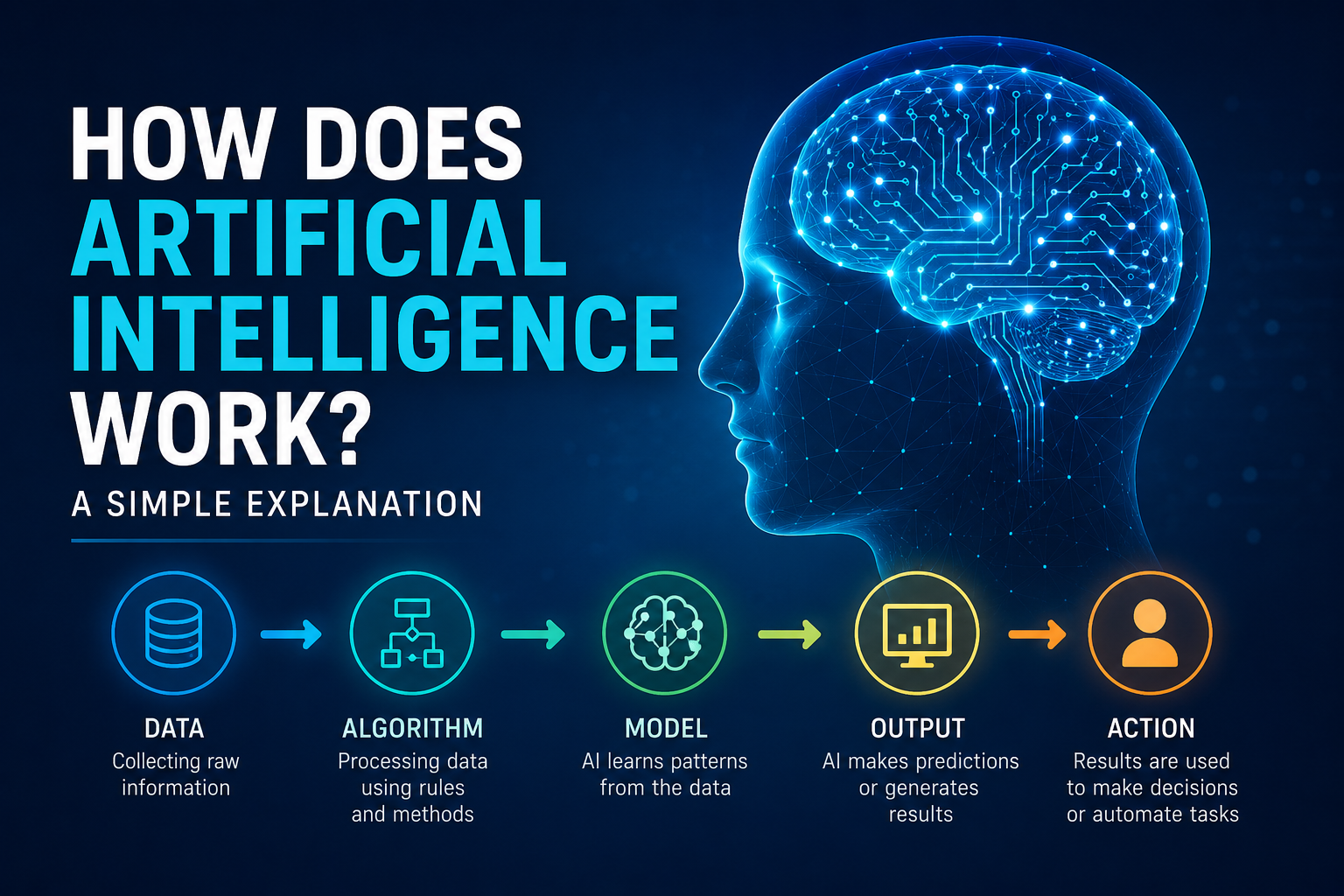
Artificial intelligence is becoming part of everyday life, from search engines and recommendation systems to virtual assistants, cybersecurity tools, and generative AI applications. While many people use AI-powered products every day, understanding how artificial intelligence actually works can be more difficult.
At a basic level, AI works by using algorithms, data, computing power, and models to identify patterns, process information, and produce useful outputs. Depending on the technology, an AI system may classify information, make predictions, understand language, recognize images, or generate new content.
If you are new to the subject, our complete guide to artificial intelligence provides a broader introduction to the fundamentals of AI.
What Is Artificial Intelligence?
Artificial intelligence is a field of computer science focused on developing systems that can perform tasks associated with human intelligence.
These tasks can include learning from information, recognizing patterns, understanding language, solving problems, making predictions, and supporting decisions.
AI does not necessarily mean that a computer thinks exactly like a human. Most AI applications available today are designed to perform specific tasks or a defined group of tasks.
For example, an AI system can analyze an image and identify objects, while another system can process text and generate a response. Both are examples of artificial intelligence, but they may use different models, datasets, and technologies.
The Basic Components of AI
Modern artificial intelligence systems can involve several important components.
Data
Data is one of the most important ingredients in modern AI.
Depending on the application, data can include text, images, audio, video, numbers, sensor readings, customer interactions, or other digital information.
For machine learning systems, data is often used to train models so they can learn patterns and relationships.
The quality of the data matters significantly. Inaccurate, incomplete, outdated, or poorly represented data can affect the performance of an AI system.
Algorithms
An algorithm is a set of instructions or mathematical processes used to solve a problem or perform a task.
AI systems use algorithms to process data, identify patterns, optimize models, and produce outputs.
Different problems require different approaches. An algorithm used for image classification may be very different from one used for language processing or recommendation systems.
AI Models
An AI model is a computational system that has been trained or configured to perform a particular task.
In machine learning, a model learns patterns from training data. Once trained, it can process new information and produce predictions or other outputs.
For example, a model trained using examples of spam and legitimate emails may learn patterns associated with unwanted messages. When it receives a new email, it can estimate whether the message is likely to be spam.
Computing Power
Modern AI can require significant computing resources, especially when training large and complex models.
Graphics processing units, specialized AI accelerators, cloud computing infrastructure, and other hardware can help process large amounts of information efficiently.
Computing resources are particularly important for large-scale machine learning and generative AI systems.
How Machine Learning Helps AI Learn
Machine learning is one of the most important technologies behind modern artificial intelligence.
Instead of programming every possible situation manually, developers can train machine learning models using data.
Imagine a system designed to identify whether an image contains a particular object. Developers can provide many examples and allow the model to learn patterns associated with that object.
During training, the model makes predictions and compares those predictions with the expected results. It then adjusts internal parameters to improve its performance.
This process can happen repeatedly across large datasets.
After training, the model can receive new information that it has not seen before and produce a prediction based on what it learned.
Training and Inference
Two important concepts in AI are training and inference.
Training is the process in which a model learns from data.
During training, the system processes examples and adjusts its internal parameters to improve its ability to perform a particular task.
Inference happens when the trained model is used to process new information.
For example, suppose an AI model has been trained to recognize certain objects in photographs. When you upload a new image, the model analyzes it and produces a result. That process is inference.
Training can require substantial computing resources, while inference requirements vary depending on the size and complexity of the model.
How AI Recognizes Patterns
Pattern recognition is central to many AI applications.
Humans can naturally recognize patterns in speech, images, numbers, and other information. AI systems can also identify patterns by analyzing large datasets.
Consider an online shopping platform. It may analyze information such as products viewed, searches performed, previous purchases, and other signals to identify patterns in customer behavior.
The system can then use those patterns to recommend products that a user may be interested in.
Similar principles can be used in fraud detection, image recognition, cybersecurity, forecasting, and many other applications.
How Natural Language Processing Works
Natural language processing, often called NLP, focuses on enabling computers to work with human language.
NLP is used in applications such as translation, search, text classification, voice assistants, chatbots, summarization, and generative AI.
Modern language models can process large amounts of text and learn relationships between words, phrases, and broader patterns in language.
When a user enters a prompt into a generative AI system, the model processes the input and generates an output based on patterns learned during training and the instructions provided by the system.
This does not mean that the model understands language in exactly the same way a human does. Its behavior is based on computational processes and learned patterns.
How Generative AI Produces Content
Generative AI systems are designed to create new content.
Depending on the model, the output may be text, images, audio, video, or software code.
For example, a text-generation model can receive a prompt and generate a response. An image-generation system can process a description and create an image based on learned visual patterns.
Large language models typically process text as smaller units called tokens. The model uses the context of the input to estimate appropriate next tokens and generate a sequence that forms the final response.
Because these systems learn from large datasets, their outputs can be highly useful. However, they can also produce incorrect, incomplete, or misleading information.
For important decisions, AI-generated information should therefore be reviewed and verified.
How Computer Vision Works
Computer vision is an area of AI focused on helping computers analyze visual information.
Computer vision systems can be used for image classification, object detection, facial recognition, quality inspection, medical imaging research, autonomous systems, and many other applications.
A computer vision model can be trained using large collections of images. During training, the model learns visual patterns that help it distinguish between different objects or categories.
Once trained, the model can analyze new images and produce predictions.
Modern computer vision systems can process increasingly complex visual information, although their accuracy depends on factors such as training data, image quality, model design, and the specific task.
How AI Makes Predictions
Many AI systems are designed to make predictions rather than provide simple yes-or-no answers.
For example, a recommendation system may estimate which product a customer is most likely to purchase. A fraud detection system may estimate the likelihood that a transaction is suspicious.
The model examines available information and produces an output based on patterns learned from data.
It is important to remember that a prediction is not necessarily a certainty. AI systems can make mistakes, particularly when they encounter unusual situations, poor-quality data, or circumstances that differ from their training environment.
Why AI Sometimes Makes Mistakes
Artificial intelligence is powerful, but it is not perfect.
One reason AI systems can make mistakes is poor-quality training data. If the data contains errors or does not adequately represent the situations the system will encounter, performance can suffer.
Another issue is that real-world situations can be more complicated than the examples available during training.
Generative AI systems can also produce what are sometimes called hallucinations, where the system generates information that sounds plausible but is incorrect.
This is why AI outputs should not automatically be treated as facts.
Human review, reliable sources, testing, and appropriate safeguards remain important.
Does AI Think Like a Human?
Modern AI systems can perform tasks that appear intelligent, but that does not mean they think exactly like humans.
Human intelligence involves many abilities, including reasoning, emotions, physical experience, social understanding, long-term memory, creativity, and contextual judgment.
AI systems are built for specific computational purposes and operate according to their architecture, training, data, and instructions.
Some AI applications can produce impressive results, but it is important to distinguish performance on a task from human-like understanding.
How AI Is Used in the Real World
Artificial intelligence is already used across many industries.
In healthcare, AI can support areas such as medical imaging analysis, research, and administrative processes.
Financial organizations can use AI for fraud detection, risk analysis, customer service, and transaction monitoring.
Businesses can use AI for customer support, forecasting, automation, marketing analysis, and productivity.
Manufacturers can use AI for quality control, predictive maintenance, and process optimization.
Cybersecurity teams can use machine learning to identify unusual activity and help detect potential threats.
Consumers interact with AI through search engines, recommendation systems, smartphones, translation tools, navigation applications, and many other digital services.
What Does AI Need to Work Effectively?
An effective AI system requires more than just a sophisticated model.
It may require high-quality data, appropriate algorithms, sufficient computing resources, careful testing, security controls, and ongoing monitoring.
The system should also be evaluated against the specific task it is designed to perform.
For business applications, organizations may need to consider privacy, compliance, security, transparency, and human oversight.
A technically impressive model is not necessarily useful if it is trained on unsuitable data or deployed without considering the real-world environment.
The Role of Humans in AI
Humans remain important throughout the AI development and deployment process.
People define problems, select data, design systems, evaluate results, establish rules, monitor performance, and make decisions about how AI should be used.
Human oversight is especially important when an AI system is involved in sensitive or high-impact decisions.
AI can automate and assist with many tasks, but responsible use requires people to understand its capabilities and limitations.
The Future of Artificial Intelligence
AI technology continues to evolve, with developments in machine learning, generative AI, robotics, computer vision, natural language processing, and AI infrastructure.
Future systems may become more capable of handling complex workflows and interacting with different software and information sources.
At the same time, important questions about privacy, security, bias, misinformation, employment, copyright, and responsible AI development will continue to shape the industry.
The future of artificial intelligence will depend not only on technical progress but also on how businesses, researchers, governments, and individuals choose to use the technology.
Frequently Asked Questions
How does artificial intelligence learn?
Many AI systems learn through machine learning, where models are trained using data to identify patterns and relationships. The model can then apply what it learned to new information.
Does every AI system use machine learning?
No. Artificial intelligence includes different approaches. Machine learning is one of the most important modern approaches, but AI systems can also involve rules, search methods, optimization, and other techniques.
Why does AI need so much data?
Many machine learning systems use large datasets to learn patterns and improve their performance. However, the amount of data required depends on the task, model, and training approach.
Can AI learn by itself?
Some AI systems can adapt or learn from new data under specific conditions, but they do not independently learn in the same broad way that humans do. Their learning processes are designed and controlled through software, data, and system architecture.
Is AI always accurate?
No. AI systems can make incorrect predictions or generate inaccurate information. Results should be evaluated according to the system’s purpose and the consequences of potential errors.
Conclusion
Artificial intelligence works by combining data, algorithms, models, computing resources, and carefully designed processes to perform tasks that can involve prediction, classification, pattern recognition, language processing, and content generation.
Machine learning has played a major role in the development of modern AI by allowing systems to learn patterns from data instead of relying entirely on manually written rules.
From recommendation engines and fraud detection to generative AI and computer vision, these technologies are already being used across many parts of modern life.
Understanding how AI works is an important first step for anyone who wants to use the technology effectively. As AI continues to evolve, learning its fundamentals can help individuals and businesses make better decisions about where the technology can provide genuine value.