
Artificial intelligence is not a single technology with one fixed level of capability. The term AI covers a broad range of systems, from simple applications designed to perform specific tasks to theoretical forms of intelligence that could potentially handle a wide variety of problems like humans.
Understanding the different types of artificial intelligence can make the rapidly changing AI landscape much easier to understand. Some AI systems are already widely used in everyday products, while others remain research concepts.
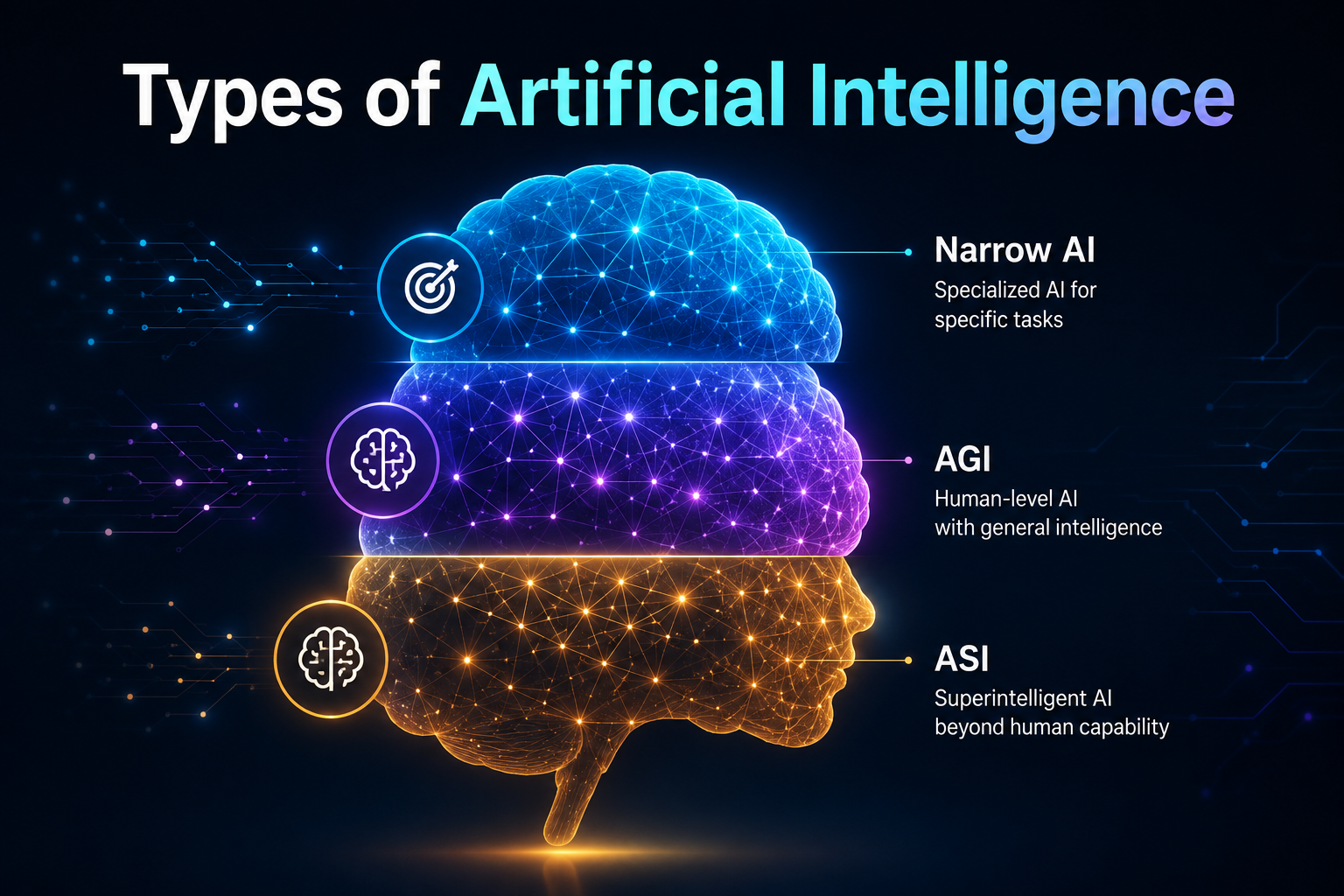
The most common way to discuss AI types is by looking at their capabilities. This includes Narrow AI, Artificial General Intelligence, and Artificial Superintelligence. AI can also be categorized based on how systems operate, such as reactive machines, limited-memory systems, theory-of-mind AI, and self-aware AI.
In this guide, we will explain these categories, how they differ, which ones exist today, and what the future of artificial intelligence may look like.
What Are the Different Types of Artificial Intelligence?
Artificial intelligence can be classified in several ways.
One approach focuses on the capability of an AI system—how broadly it can perform intellectual tasks. Another approach focuses on its functionality, or how the system processes information and interacts with its environment.
When people discuss the major types of AI, they most commonly refer to:
- Narrow AI
- Artificial General Intelligence
- Artificial Superintelligence
The first category represents the AI systems that are actually being used widely today. The other two describe potential future forms of AI and remain subjects of research and debate.
To understand these categories properly, it is useful to first look at Narrow AI.
What Is Narrow AI?
Narrow AI, also known as Weak AI, refers to artificial intelligence designed to perform specific tasks or a limited range of tasks.
Most AI applications currently available in the real world fall into this category.
A Narrow AI system can be extremely capable within its particular area without having broad, human-like intelligence.
For example, an AI-powered image recognition system may be very effective at identifying objects in photographs. However, that same system may not be capable of writing an article, planning a trip, or solving an unrelated business problem.
Similarly, a recommendation system can analyze user behavior and suggest products, movies, music, or other content. Its intelligence is focused on the task it was designed to perform.
Examples of Narrow AI
Narrow AI is already present in many technologies people use every day.
Examples include:
- Search engine algorithms
- Recommendation systems
- Spam detection
- Fraud detection
- Voice assistants
- Image recognition
- Translation systems
- Navigation applications
- AI-powered customer service
- Product recommendation engines
- Generative AI applications
These systems can perform useful tasks without possessing general human intelligence.
How Narrow AI Works
Narrow AI systems are usually developed for a clearly defined purpose.
Depending on the application, developers may use machine learning, deep learning, natural language processing, computer vision, rules-based systems, or a combination of different technologies.
For example, a spam detection system can be trained using large amounts of email data. The system learns patterns associated with unwanted messages and can then classify new messages based on those patterns.
The system does not need to understand every aspect of human communication. It only needs to perform its intended classification task effectively. If you are new to the subject, our complete guide to artificial intelligence.
For readers who want to understand the underlying technology, our guide on how artificial intelligence works explains how data, algorithms, models, and computing resources work together in modern AI systems.
Advantages of Narrow AI
Narrow AI has several practical advantages.
First, it can be highly effective at specialized tasks. Developers can optimize a system for a particular problem rather than trying to create a general-purpose intelligence.
Narrow AI can also automate repetitive activities, analyze large datasets, identify patterns, and provide useful predictions.
Businesses can use specialized AI systems to improve productivity, customer service, fraud detection, cybersecurity, marketing analysis, and many other operations.
Another advantage is that the performance of a specialized AI system can often be evaluated against clearly defined objectives.
Limitations of Narrow AI
The biggest limitation of Narrow AI is its lack of general intelligence.
A system designed for one task usually cannot automatically transfer its knowledge to completely unrelated tasks.
For example, an AI system designed to detect fraudulent financial transactions does not automatically know how to diagnose a medical image or write computer software.
Even highly advanced AI applications remain dependent on their design, training, available information, and operating environment.
This is one of the major differences between today’s AI systems and the concept of Artificial General Intelligence.
What Is Artificial General Intelligence?
Artificial General Intelligence, commonly abbreviated as AGI, refers to a hypothetical form of AI capable of performing a broad range of intellectual tasks with a level of flexibility comparable to human intelligence.
Unlike Narrow AI, AGI would not be limited to one particular task.
A theoretical AGI system could potentially learn new skills, reason across different domains, understand unfamiliar situations, solve different types of problems, and transfer knowledge from one area to another.
For example, a true general intelligence might be able to learn programming, analyze scientific information, understand a business problem, write an explanation, and then apply its knowledge to a completely different task.
The exact definition of AGI is still debated. Researchers and technology experts do not have one universally accepted test that determines when an AI system should be considered generally intelligent.
How Would AGI Differ From Narrow AI?
The main difference is the breadth of capability.
A Narrow AI system is created to solve a particular problem or a defined group of problems.
AGI, by contrast, would theoretically be able to handle a much wider variety of intellectual tasks.
Consider a navigation application. It can process maps, traffic information, and routes extremely well, but that does not make it a general intelligence.
An AGI system would theoretically be able to learn how navigation works and then use its broader reasoning abilities to handle unrelated tasks.
This flexibility is one of the defining ideas behind AGI.
Has AGI Been Achieved?
There is currently no universally accepted evidence that Artificial General Intelligence has been achieved.
Modern AI systems can perform impressive tasks across multiple domains, especially with the development of large language models and multimodal systems. However, broad performance across many tasks does not automatically establish that a system has human-level general intelligence.
Questions remain about reasoning, reliability, adaptability, long-term learning, autonomy, understanding, and the ability to operate effectively in unfamiliar environments.
For this reason, AGI should currently be treated as a research concept and future possibility rather than an established category of everyday technology.
Potential Characteristics of AGI
A theoretical AGI system might have several characteristics that distinguish it from Narrow AI.
It could potentially learn new tasks with limited additional training, transfer knowledge between different domains, reason about unfamiliar problems, adapt to changing environments, and use existing knowledge in new situations.
It might also be able to combine different capabilities rather than requiring a separate specialized system for each task.
However, these characteristics describe a theoretical goal rather than a checklist that current systems have definitively achieved.
What Is Artificial Superintelligence?
Artificial Superintelligence, or ASI, is another theoretical concept.
It refers to an AI system whose intellectual capabilities would substantially exceed human capabilities across many or most areas of intelligence.
While AGI is generally described as having broad human-like intellectual capabilities, ASI represents a hypothetical level beyond human intelligence.
An ASI system, in theory, could outperform humans in areas such as scientific reasoning, mathematics, strategic planning, engineering, and other intellectual activities.
No confirmed Artificial Superintelligence currently exists.
Narrow AI vs AGI vs ASI
The three concepts can be summarized in simple terms.
Narrow AI is designed for specific tasks.
AGI would theoretically have broad, human-like general intelligence.
ASI would theoretically exceed human intelligence across a wide range of intellectual abilities.
The distinction is therefore primarily about capability and generality.
| Type | Capability | Current Status |
|---|---|---|
| Narrow AI | Specialized tasks | Widely used |
| AGI | Broad human-like intelligence | Theoretical/research goal |
| ASI | Intelligence beyond humans | Hypothetical |
This table provides a simplified overview. The boundaries and definitions can vary depending on the researcher or organization discussing AI.
Another Way to Classify AI: By Functionality
AI can also be classified based on how a system processes information and interacts with its environment.
This approach commonly includes reactive machines, limited-memory systems, theory-of-mind AI, and self-aware AI.
These categories are useful for understanding different ideas about AI behavior, but not all represent established technologies.
Reactive Machines
Reactive machines represent a basic form of AI functionality.
These systems respond to current inputs without maintaining a meaningful memory of past experiences.
They can analyze the information available at the moment and produce an output based on their programmed or learned behavior.
A classic example often discussed in AI history is IBM’s Deep Blue chess system, which could analyze chess positions and make decisions based on the game state.
Reactive systems can be effective for specific tasks, but their functionality is limited because they do not use memory in the same way more advanced AI systems can.
Limited-Memory AI
Limited-memory AI systems can use information from previous interactions or historical data when producing outputs.
Many modern machine learning applications fall broadly into this category.
For example, a self-driving technology system may process recent information from cameras and other sensors to understand its environment and make driving-related decisions.
Recommendation systems can also analyze previous user behavior to improve future recommendations.
The term “limited memory” does not necessarily mean that these systems remember information exactly as humans do. It describes how past information can be incorporated into the system’s operation.
Theory of Mind AI
Theory of mind AI is a theoretical concept based on the idea that an AI system could understand aspects of human mental states, such as beliefs, intentions, emotions, or perspectives.
Humans naturally consider what other people may be thinking or feeling when communicating and making decisions.
An AI system with a robust theory of mind would theoretically be able to account for these factors in a more sophisticated way.
Research into social intelligence and human-AI interaction continues, but a fully developed theory-of-mind AI system matching the concept described in AI theory has not been established.
Self-Aware AI
Self-aware AI represents an even more theoretical concept.
A self-aware AI system would theoretically possess a form of consciousness or awareness of itself.
This concept is often discussed in science fiction and philosophical debates about the future of artificial intelligence.
There is currently no established scientific evidence demonstrating the existence of genuinely self-aware AI systems.
It is therefore important to distinguish theoretical concepts from the AI technologies available today.
Why Understanding AI Types Matters
Understanding different types of artificial intelligence helps people separate current technology from future possibilities.
Marketing discussions sometimes use terms such as AGI or advanced AI broadly, even when the technology being described is still a specialized system.
Knowing the difference between Narrow AI and theoretical forms of general intelligence can help businesses, students, developers, and everyday users evaluate AI claims more carefully.
It also provides a useful framework for thinking about where the technology may go in the future.
How AI May Evolve in the Future
Artificial intelligence is developing rapidly, particularly in areas such as generative AI, machine learning, robotics, computer vision, natural language processing, and multimodal systems.
Future AI systems may become more capable of handling multiple types of tasks and working across different information sources.
However, predicting exactly when or whether AGI or ASI will be achieved is difficult.
Technical challenges, safety considerations, economic factors, research breakthroughs, regulation, and our understanding of intelligence itself may all influence the future development of AI.
Frequently Asked Questions
What is the most common type of AI today?
Narrow AI is the most common type of artificial intelligence currently used. Most real-world AI applications are designed for specific tasks or limited areas.
Is ChatGPT Narrow AI?
Modern conversational AI systems can perform many different tasks, but whether they should be classified strictly as Narrow AI depends on the definition being used. They are not generally considered proven Artificial General Intelligence.
Is AGI available today?
There is no universally accepted evidence that AGI has been achieved. AGI remains an active area of research and debate.
What is the difference between AI and AGI?
AI is a broad term covering artificial intelligence technologies and applications. AGI refers specifically to a hypothetical form of AI with broad, general-purpose intellectual capabilities.
What is ASI?
ASI stands for Artificial Superintelligence. It is a hypothetical form of intelligence that would significantly exceed human intellectual capabilities across many areas.
Are self-aware AI systems real?
There is currently no established evidence that genuinely self-aware AI systems exist. Self-aware AI remains a theoretical concept.
Conclusion
Artificial intelligence includes a wide range of technologies and concepts, from specialized systems already used in everyday applications to theoretical forms of intelligence that could have much broader capabilities.
Narrow AI is currently the dominant form of practical AI. It can perform specific tasks such as recognizing images, recommending content, detecting fraud, processing language, and generating content.
Artificial General Intelligence represents the idea of a system capable of handling a broad range of intellectual tasks, while Artificial Superintelligence describes a hypothetical level of intelligence beyond human capabilities.
AI can also be classified according to functionality, including concepts such as reactive machines, limited-memory AI, theory-of-mind AI, and self-aware AI.
Understanding these distinctions is useful as artificial intelligence continues to evolve. By separating current capabilities from theoretical possibilities, people can better understand AI developments and make more informed decisions about how the technology may affect the future.